
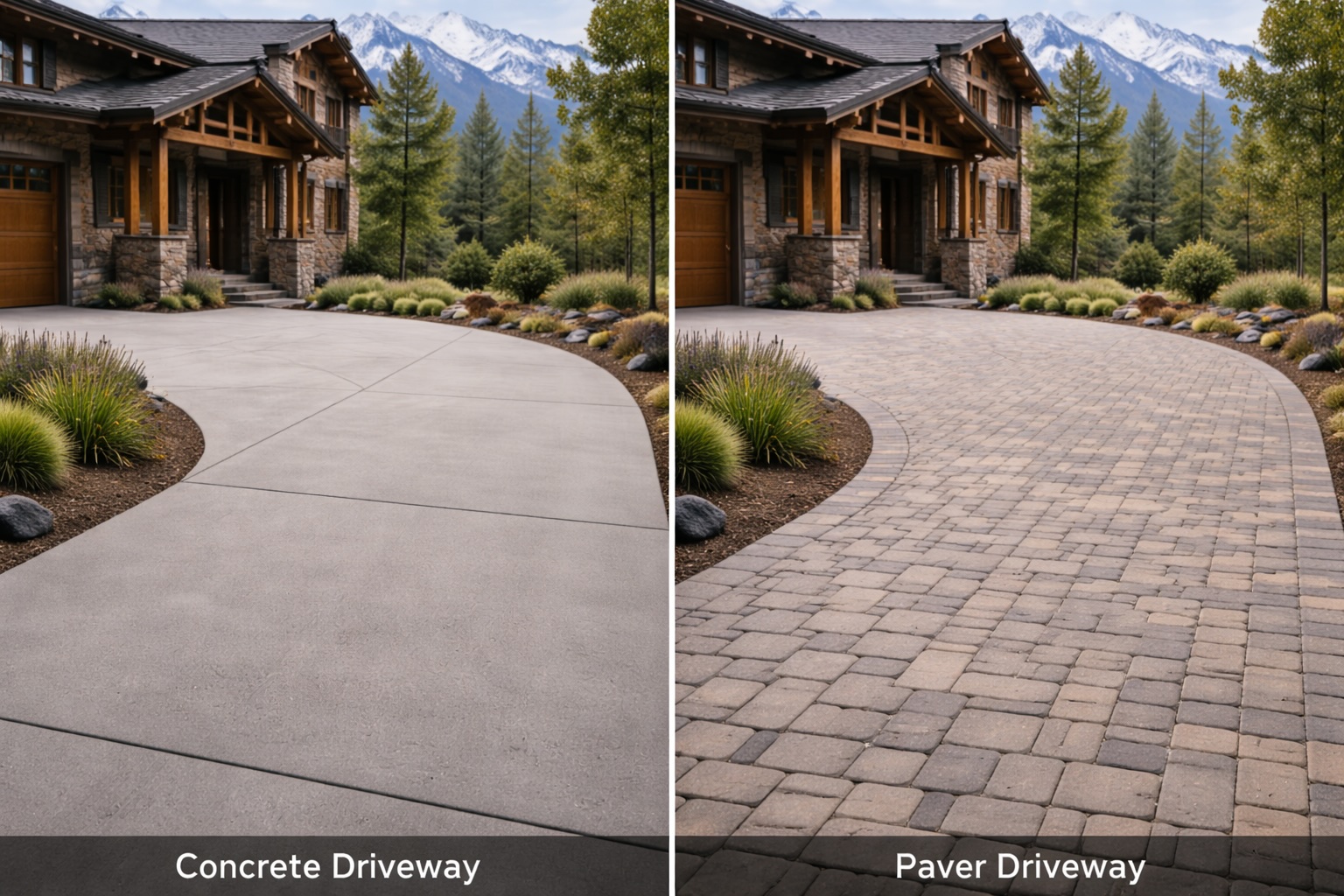
Flatwork decisions shape your property’s functionality and appearance for decades. Whether planning driveways, patios, or walkways, choosing between concrete and pavers affects initial costs, long-term maintenance, and how well surfaces withstand Colorado’s demanding climate.
Both options serve effectively when properly installed, but they perform differently under our conditions. Understanding these differences helps you select materials that match your priorities and budget.
Poured Concrete: The Traditional Choice
Poured concrete creates continuous surfaces that handle vehicle loads reliably while offering design flexibility through various finishes. The material’s widespread use reflects its proven performance and accessible costs.
Cost and Installation
Concrete installation runs $6-12 per square foot for basic applications. Enhanced options like decorative stamping, coloring, or exposed aggregate increase costs to $10-18 per square foot. Installation speed favors concrete significantly. Crews can pour and finish large areas in single days, though concrete requires 7-28 days to cure fully before accepting heavy loads.
The process demands expertise for lasting results. Proper subgrade preparation prevents settling. Correct reinforcement placement resists cracking. Strategic control joint spacing manages shrinkage predictably. These details separate quality installations from problematic ones.
Durability and Maintenance
Well-installed concrete driveways last 25-30 years in Colorado with proper care. Patios and walkways often exceed 30 years since they avoid vehicle loads. However, our freeze-thaw cycles can cause surface scaling and cracking if water penetrates.
Sealing concrete every 2-3 years protects against moisture penetration and surface damage. Quality sealers cost $0.50-1.00 per square foot applied. Skip sealing and concrete deteriorates faster, developing surface spalling and accelerated wear.
Crack repair becomes necessary over time. Small cracks can be filled, though repairs rarely disappear completely. Large cracks may require cutting out and replacing sections. The continuous nature means damage in one area remains visible even after repair.
Stains from oil, rust, or other substances penetrate concrete readily. While cleaning products address many stains, some become permanent. This matters more for patios and walkways where appearance counts than for driveways where staining seems inevitable.
Design Flexibility
Basic concrete offers limited aesthetic options in its natural gray state. However, various techniques create more interesting appearances. Stamped concrete replicates stone, brick, or tile patterns at lower costs than actual pavers. Integral color or applied color hardeners create diverse hues.
Exposed aggregate finishes reveal decorative stone within the concrete mix, creating textured surfaces with visual interest and better traction than smooth concrete. The techniques add character but require skilled installation. Poor stamping looks obviously fake, and uneven coloring creates blotchy appearances.
Pavers: Modular Flexibility
Pavers use individual units (concrete, brick, or stone) to create surfaces with inherent design flexibility. The modular nature allows patterns, color combinations, and easier repairs than poured concrete.
Cost and Installation
Concrete pavers cost $10-20 per square foot installed for standard products. Premium pavers or intricate designs increase costs to $15-30 per square foot. Natural stone pavers run $20-40 per square foot depending on stone type.
Installation takes longer than poured concrete since each paver requires individual placement. However, pavers become usable immediately without curing time. The process requires precision for lasting performance. Proper base preparation, edge restraints to prevent creep, and sand between joints all affect long-term stability.
Durability and Maintenance
Quality pavers last 25-40 years with proper installation and maintenance. The modular nature helps them handle freeze-thaw cycles better in some ways. Individual pavers can shift slightly without creating continuous cracks, though this movement requires occasional releveling.
Joint sand washes out over time, requiring replenishment every few years. Polymeric sand resists washout better but costs more. Weeds can grow between pavers if joints aren’t maintained, though regular sweeping and occasional herbicide application controls this.
The permeable nature allows better water drainage than solid concrete, reducing ice formation during winter and preventing water pooling. For Colorado properties with drainage concerns, this offers real advantages.
Repair and Replacement
Pavers excel at repair simplicity. Damaged units can be removed and replaced individually without affecting surrounding areas. This contrasts sharply with concrete where repairs always remain visible.
Settling or heaving can be addressed by lifting affected pavers, correcting the base, and resetting them. This proves far simpler than addressing settled concrete sections.
Color matching becomes an issue with older installations since pavers fade over time. Some manufacturers maintain product lines for years, helping with future repairs, while others discontinue colors and styles regularly.
Design Options
Pavers provide extensive design flexibility through color combinations, patterns, and borders. Herringbone, basket weave, running bond, and circular patterns create visual interest. Different colors can define spaces or create borders.
This flexibility allows creativity that poured concrete cannot match economically. The ability to create curves, circles, and custom shapes suits landscape designs requiring organic forms. Texture options range from smooth to heavily textured surfaces, serving both aesthetic and functional purposes.
Climate Performance Comparison
Colorado’s freeze-thaw cycles challenge both materials differently. Concrete can suffer surface scaling when water penetrates and freezes. Proper air entrainment during mixing and regular sealing minimize this damage. Pavers handle freeze-thaw through individual units shifting slightly, accommodating ice expansion without cracking.
Both materials require proper installation for freeze-thaw resistance. Adequate base depth, proper compaction, and good drainage matter more than material choice for long-term performance.
Snow removal equipment affects materials differently. Plow blades can catch paver edges, potentially dislodging units if not installed correctly. Concrete’s continuous surface handles plowing better, though operators can still damage edges and control joints.
Salt and deicing chemicals affect both materials. Concrete can suffer surface damage from aggressive deicers, particularly during the first year. Pavers generally resist chemical damage better, though joint sand may wash away faster with heavy salt use.
Colorado’s intense sun fades both materials over time. Integral colored concrete maintains color better than surface-applied colors. Pavers manufactured with color throughout the unit resist fading better than surface-tinted products. Both materials benefit from periodic sealing that includes UV inhibitors.
Making Your Decision
Initial installation costs favor concrete for large areas. A 500-square-foot driveway might cost $3,000-6,000 in basic concrete versus $5,000-10,000 in pavers. However, lifetime costs include maintenance and repairs. Concrete’s lower initial cost gets offset partially by sealing costs and repair difficulty.
Consider how long you plan to own your property. If selling within 5-10 years, lower-cost concrete might make sense. Longer ownership periods favor investing in materials that maintain appearance with reasonable maintenance.
Driveways handling heavy vehicles or frequent traffic favor concrete’s continuous surface. The material resists rutting and edge damage better, though quality paver installations also serve driveways effectively. Patios and walkways benefit from pavers’ design flexibility and easier repairs. Pool surrounds and areas with drainage challenges often perform better with pavers’ permeable characteristics.
If you want design flexibility, patterns, and color variations, pavers deliver options concrete cannot match economically. If you prefer clean, modern aesthetics with minimal visual complexity, poured concrete creates unified surfaces that suit contemporary designs.
Professional Installation Matters
Both concrete and pavers require skilled installation for lasting performance. Experienced Colorado flatwork contractors understand regional requirements including proper base depth for frost protection, drainage specifications for our climate, and techniques that ensure surfaces withstand temperature extremes and freeze-thaw cycles.
Poor installation undermines even quality materials. Inadequate base preparation causes settling. Improper drainage creates ice problems and accelerates deterioration.
Frequently Asked Questions
Which costs more, concrete or pavers?
Concrete costs $6-12 per square foot for basic installations. Pavers cost $10-20 per square foot for standard products. Initial installation favors concrete, though lifetime costs including maintenance narrow the gap.
Which lasts longer in Colorado?
Both materials last 25-30+ years with proper installation and maintenance. Quality pavers may last 25-40 years. Climate exposure and maintenance affect longevity more than material choice.
Can pavers handle Colorado freeze-thaw cycles?
Yes, properly installed pavers handle freeze-thaw well. The modular nature allows slight movement that accommodates ice expansion. Adequate base preparation and drainage prove essential.
Which is easier to repair?
Pavers repair more easily since individual units can be removed and replaced. Concrete repairs remain visible and sometimes require replacing entire sections for acceptable appearance.
Do I need to seal concrete or pavers?
Sealing benefits both materials in Colorado. Concrete needs sealing every 2-3 years to prevent moisture damage and staining. Pavers benefit from sealing every 2-4 years, though it’s less critical.
Which provides better traction when wet?
Textured pavers generally provide better traction than smooth concrete. Stamped or exposed aggregate concrete offers traction comparable to pavers. Both can be finished for adequate wet traction.
Planning Your Flatwork Project
Material selection for driveways, patios, and walkways involves balancing initial costs, maintenance requirements, aesthetic goals, and performance needs. Both concrete and pavers serve effectively when properly installed and maintained.
Ready to plan flatwork that serves your property well? Contact us today to discuss your project and receive expert guidance on material selection that meets your needs while handling Colorado’s demanding conditions.