
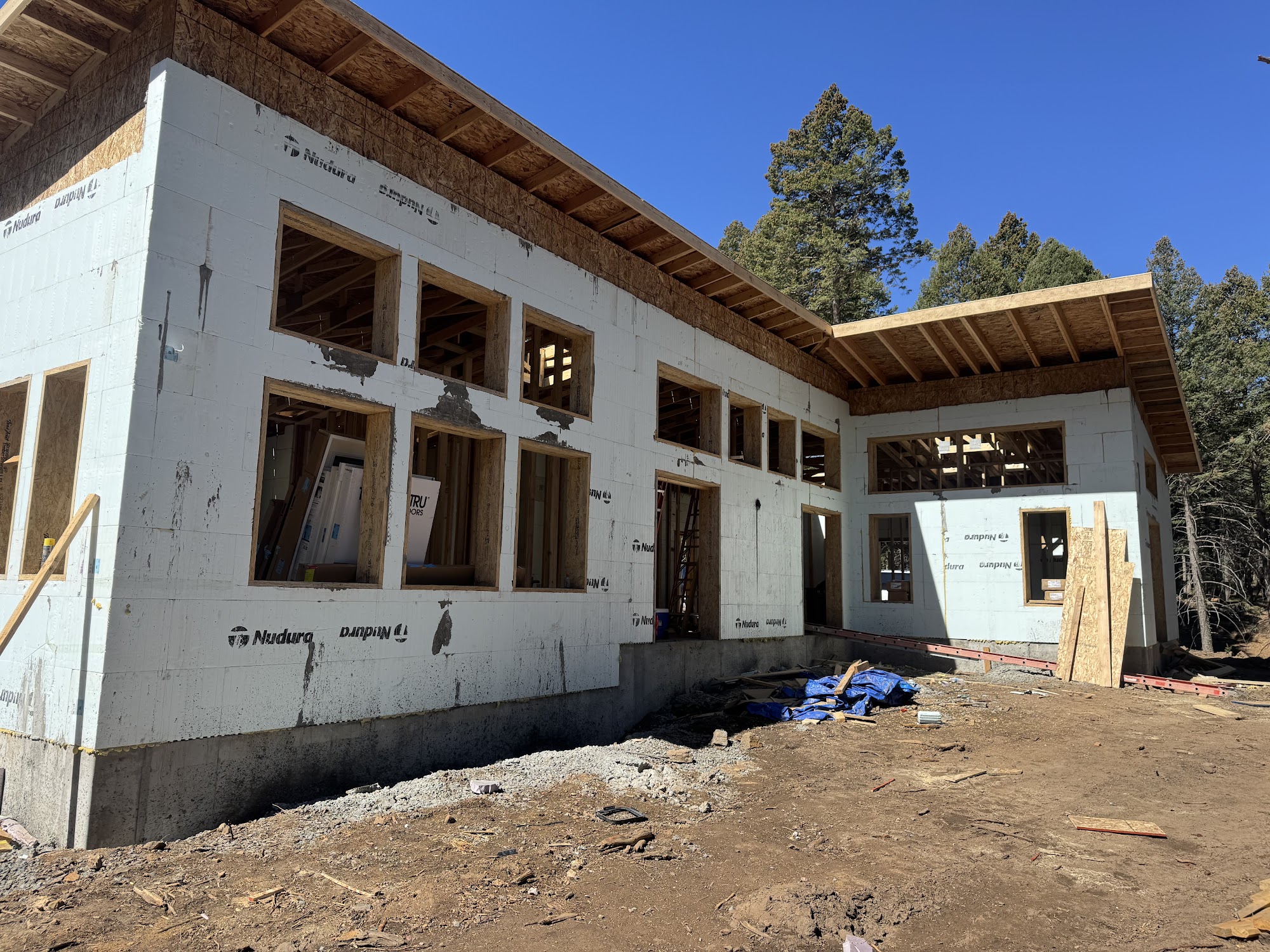
TL;DR: ICF construction stacks foam blocks filled with reinforced concrete to build walls that resist wildfire, hold heat at altitude, and stand up to Colorado’s freeze-thaw cycles.
ICF construction, short for insulated concrete form construction, is a building method that uses interlocking foam blocks as the formwork for cast-in-place reinforced concrete walls. Crews stack the blocks, brace them, lace in steel reinforcing, and pour concrete into the cavity. The foam stays in place permanently as the interior and exterior insulation layer. What you end up with is a wall that doubles as a poured concrete shear wall and a deep continuous insulation envelope. From the curb, it looks no different from a conventionally framed home once the finishes go on.
In Colorado, that combination of properties has made ICF the go-to method for mountain custom homes and wildfire-zone rebuilds. It also wins on projects where the owner wants the building to outperform conventional framing on energy, fire resistance, and durability over a forty-to-sixty-year horizon.
How an ICF Wall Is Actually Built
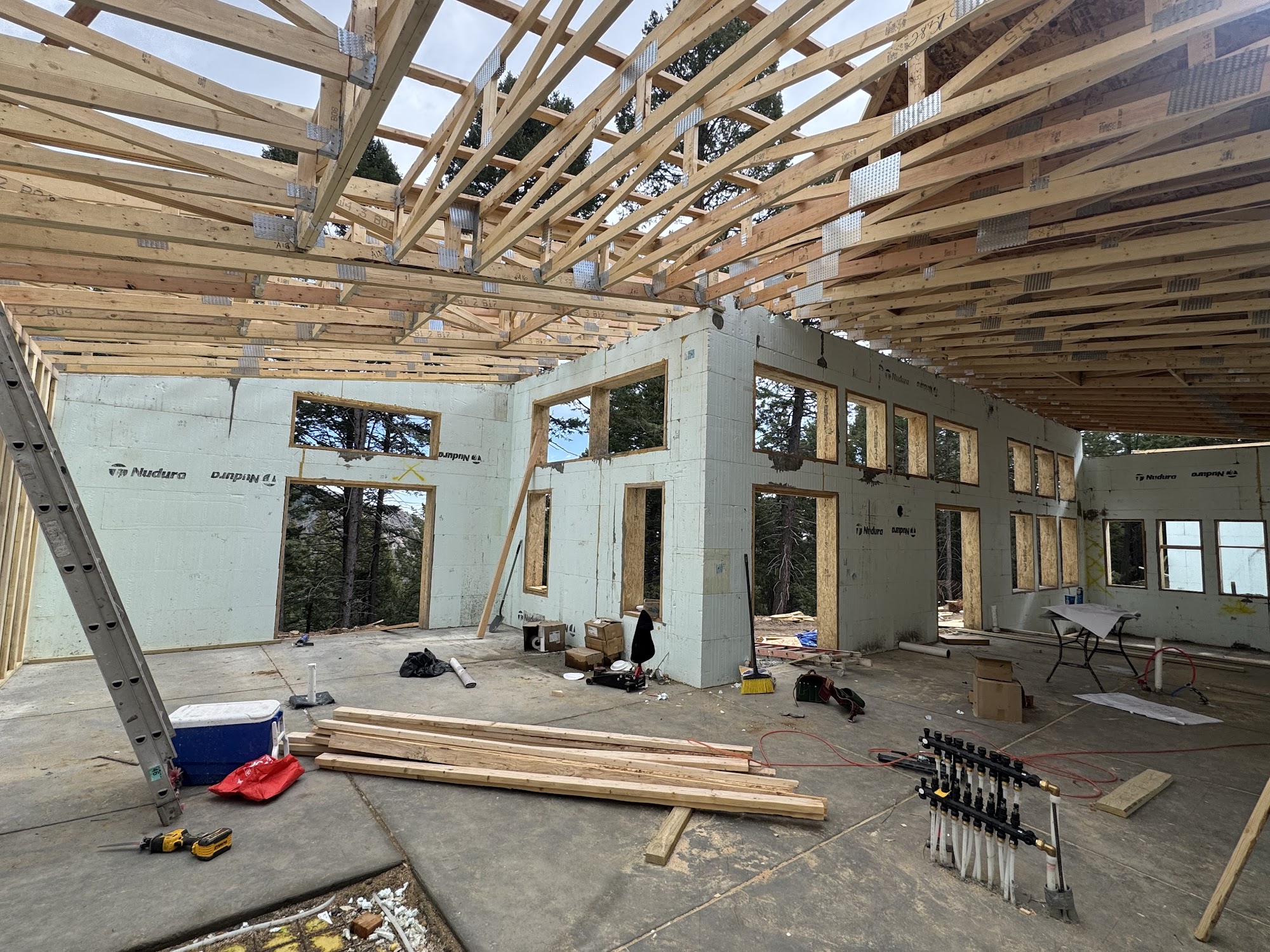
The build sequence is straightforward once you’ve seen it. The foundation gets poured first, just like any other home. The first course of ICF blocks goes on top of the foundation and gets leveled carefully, because every course above depends on it. Each block runs roughly four feet long and sixteen inches tall, with a thickness somewhere between eleven and seventeen inches depending on the system and the wall design. The blocks interlock vertically and horizontally like oversized Lego pieces, and plastic webs hold the two foam faces apart while creating channels for reinforcing steel.
Crews place rebar horizontally on top of each course and vertically every few feet, following the structural engineer’s plan. Door and window openings get framed inside the forms with lumber bucks. Once the wall reaches the planned height, a bracing and scaffolding system goes up on one side to hold the forms perfectly plumb during the pour.
Concrete then goes in three or four feet at a time, with a vibrator consolidating the mix at each lift to drive out voids. The pour wraps in a single day for most residential walls. A few days of curing later, the bracing comes off and the forms stay put as the finished insulation, ready for the electrician’s chases, the plumber’s penetrations, and the drywaller’s screws.
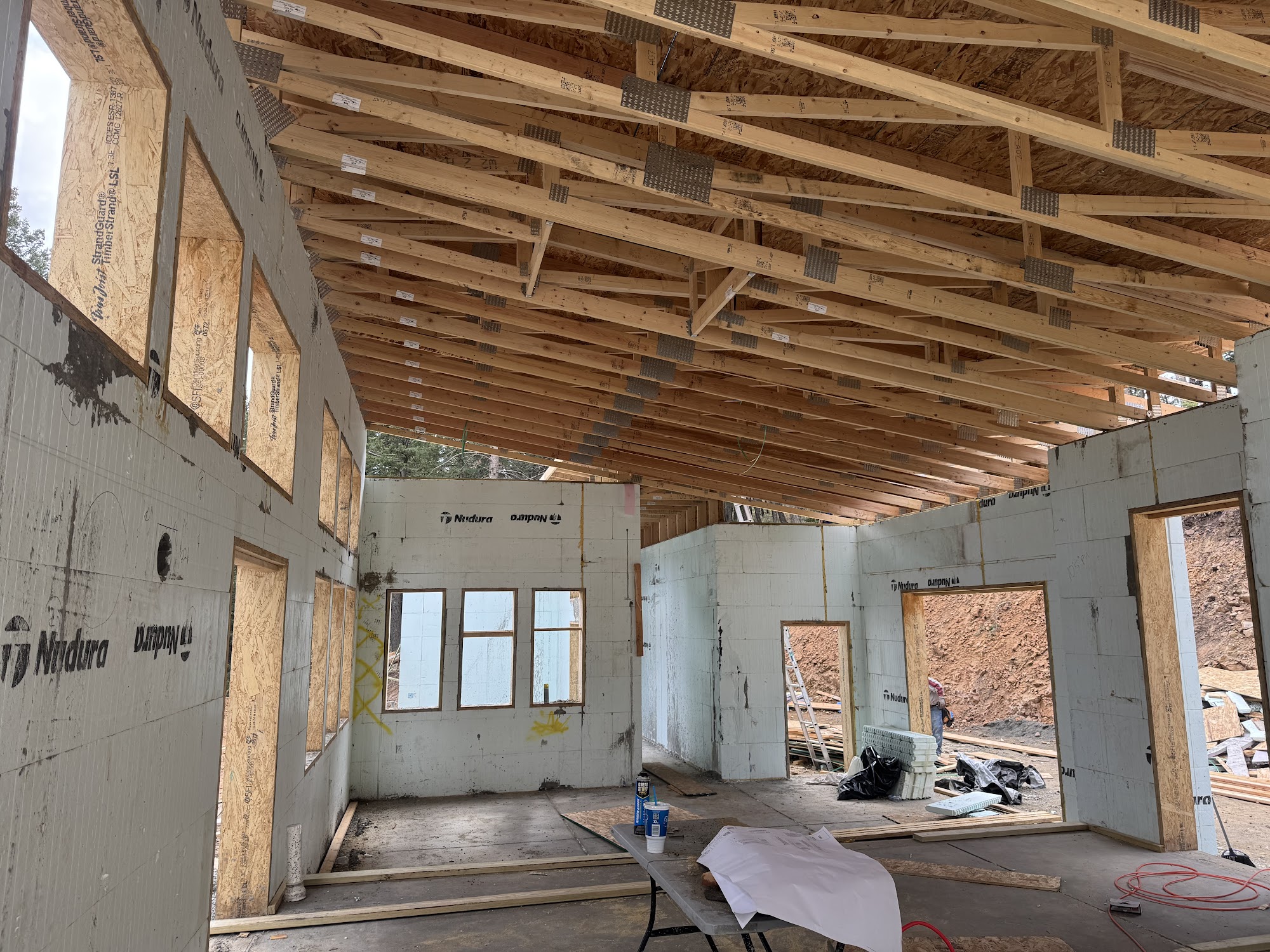
The interior face takes drywall directly. The exterior face accepts stucco, fiber-cement siding, masonry veneer, board-and-batten, or any other finish the owner wants. From the outside, an ICF home looks identical to a framed home. The difference lives entirely under the skin, where a solid six to eight inches of concrete sits between two layers of high-density foam. Our Denver ICF construction crew has been building walls across the metro and the mountains long enough to maintain a stable rotation, which matters because ICF rewards experience and punishes inexperience faster than conventional framing.
Why Colorado Is an ICF Sweet Spot
Three Colorado-specific conditions push the math heavily in ICF’s favor over traditional framing.
Wildfire risk comes first. Colorado’s wildland-urban interface zones have seen losses on a scale that has shifted how insurers and homeowners think about exterior construction. ICF walls do not burn. The concrete core has no fuel value, and the exterior foam usually sits behind stucco, fiber cement, or another non-combustible finish that meets the ASTM E84 ratings recognized by the International Code Council.
The wall on its own does not make a home fireproof. Roof assembly, eave details, vents, and surrounding vegetation matter just as much. What ICF does eliminate is the wall as a failure point during the kind of ember-driven wildfire that destroyed Marshall Fire homes in 2021 and 2022.
The heating-dominant climate is the second factor. Denver averages over six thousand heating degree days per year, and mountain towns above seven thousand feet of elevation can clear nine thousand. The concrete core’s thermal mass, paired with continuous foam insulation on both sides, produces an effective R-value far higher than the foam’s label rating. The concrete slows heat transfer through the wall to a crawl.
Energy bills drop, peak loads drop, and the HVAC system can often be downsized one tier compared to a framed home of the same square footage. The performance pattern is consistent enough that whole-wall R-values in the thirties and forties show up regularly in field reports from builders working in heating-dominated climates.
Durability against freeze-thaw and seismic loads is the third factor. Concrete cycles through freeze-thaw far better than the lumber, sheathing, and house wrap of a framed assembly. Properly reinforced ICF walls also carry substantial lateral capacity, which matters in the parts of Colorado where wind loads and seismic considerations meaningfully shape structural design. None of these performance advantages require the homeowner to give up architectural style. ICF homes can be modern, rustic, traditional, or anything else the finishes allow.
Cost, Build Time, and What Surprises Homeowners
Cost is the first question almost every homeowner asks. In the Denver metro, the up-front material and labor premium for an ICF shell runs five to ten percent over a comparable 2×6 framed shell. Mountain builds run slightly higher because access and crew logistics push costs up. That premium recovers itself through energy savings over fifteen to twenty years for most homes, and quite a bit faster in mountain climates where heating costs are higher.
Build-time is more nuanced. At the wall stage, ICF can move slightly faster than framing once the crew is dialed in, because the assembly skips sheathing, house wrap, and a separate insulation step. On the other hand, the foundation has to be more precise, the concrete pour needs good weather or winter precautions, and the structural engineer’s review takes longer since every ICF home is essentially a small concrete building. In practice, an ICF custom home in the mountains runs roughly the same total schedule as a framed home of the same scope. The timing tradeoffs simply land in different places.
The real surprises usually show up in three places. Plumbing and electrical chases have to be planned and cut into the foam before drywall, which is a different workflow than running wire through stud bays. Hanging anything heavy on an ICF wall calls for masonry anchors or fasteners that engage the concrete, not drywall anchors.
Anyone planning to remodel later should know that moving an exterior wall is not realistic on an ICF home the way it is on a framed home. Interior remodels, additions, and finish updates are all fine, but the structural shell is meant to be a forty-to-sixty-year decision. Our Colorado custom home builds work with that separation in mind, so cladding, fenestration, and finishing updates stay straightforward later on without disturbing the wall structure.
Common Misconceptions About ICF
One common misconception treats ICF as a recent or experimental method. Builders have used ICF in North America for more than four decades and in Europe for even longer. The major brands, Nudura, Fox Block, Quad Lock, Super Form, and BuildBlock, all hold ICC Evaluation Service Reports verifying compliance with the International Residential Code and the International Building Code. ICF is not a niche technology. It is a code-recognized wall system with an established supply chain.
The second misconception is that ICF homes feel like concrete bunkers. They do not. The interior surfaces are drywall, the floors are whatever the homeowner specifies, the windows are conventional, and the architectural style is whatever the design calls for. However, homeowners do notice one experiential difference: acoustics. ICF homes feel notably quieter, with less outdoor noise penetrating the walls and less sound transmission between rooms.
A last common misconception is that ICF only pays off on full custom homes. In reality, ICF garages, additions, basement walls, and accessory dwelling units all carry the same performance benefits at a proportionally smaller scale. A detached garage built with ICF in a wildfire-prone zone, for instance, can serve as a defensible-space barrier between the main house and the wildland boundary while still working as a practical workshop or vehicle storage space.
Is ICF Right for Your Colorado Project?
ICF tends to make sense when at least two of four conditions apply. The property sits in a wildfire-risk zone or wildland-urban interface area. The heating load runs high, whether from mountain elevation, large window area, or a homeowner who keeps the thermostat warm. The building will see long-term occupancy as a forever home, multi-generational property, or a serious rental. Or homeowner’s insurance has become hard to obtain or hold on the property in question.
If only one of those is true, conventional framing with high-performance insulation may produce comparable results at a lower up-front cost. When three or four apply, ICF is almost always the right answer. To talk through your specific lot, design, and budget, get a free estimate and we will walk you through where ICF fits and where it doesn’t.
Frequently Asked Questions
How does ICF construction compare to traditional framing on R-value?
The foam alone in a typical ICF wall provides R-22 to R-25, but the concrete mass and the continuous insulation envelope push effective performance well above the label number. Whole-wall performance routinely tests in the R-30 to R-50 range, depending on the climate model used.
Is ICF construction more expensive than traditional framing?
In the Denver metro, the wall-shell up-charge over 2×6 framed assemblies typically runs five to ten percent on a custom home, with mountain builds slightly higher. The total project cost difference usually comes in smaller than the wall-shell difference, because finishes, mechanical, and site work stay the same.
Can ICF be used for detached garages and ADUs, or only main homes?
In fact, ICF works for detached garages, accessory dwelling units, additions, and basement walls. The performance benefits (fire resistance, energy efficiency, durability) scale down with the project but do not disappear. For example, ICF garages and ICF ADUs are common in Colorado mountain communities for the same reasons as mountain custom homes.
What ICF brands are commonly used in Colorado?
The major systems in Colorado include Nudura, Fox Block, Quad Lock, Super Form, and BuildBlock. Each holds an ICC Evaluation Service Report covering code compliance, and each has slightly different block geometry and tie-spacing that shape how the system performs on a specific design.
Does ICF construction qualify for any insurance discounts?
Some carriers offer discounts for non-combustible exterior wall construction, and others don’t. In current Colorado conditions, the bigger insurance benefit is often the ability to obtain or hold coverage at all, since many wildfire-prone zip codes now see non-renewals on conventional homes. Specific carrier behavior varies, so anyone counting on a discount should confirm with their agent.